Extractive Industry · Anosy Region

Mining Sector

Anosy's leading industrial engine — ilmenite, zircon and rare earths from Mandena, high-potential mica, fine stones and industrial stones, vertical integration with the Port of Ehoala and decarbonisation through renewable energy. A world-scale value chain.

2008 QMM Mandena start-up
>$131 M taxes paid to the State
9 value chains analysed
30 MW QMM renewables
Context of Anosy's mining sector

A structuring sector
at the heart of the regional economy

Madagascar's mining sector

Madagascar is among the world's significant producers of cobalt, graphite, ilmenite, mica, nickel, rare earths and zircon (USGS, Mineral Industry of Madagascar). Mining accounts for a substantial share of Malagasy exports by value. The sector is now governed by Law No. 2023-007 of 27 July 2023 overhauling the Mining Code and overseen by the Extractive Industries Transparency Initiative (EITI), which Madagascar has been part of since 2008. Mining permits are granted by the Madagascar Mining Cadastre Office (BCMM).

Source: USGS — Mineral Industry of Madagascar 2019 · EITI Madagascar · BCMM · Ministry of Mines (mines.gov.mg)

Position of the Anosy Region

The Anosy Region holds one of the largest mineral-sand deposits in the Indian Ocean at Mandena, mined since 2008 by QIT Madagascar Minerals (QMM), a joint venture between Rio Tinto and the Malagasy State (partnership renewed in 2023). Since 2006, QMM has paid more than 131 million dollars in taxes to the Malagasy State. Amboasary Sud district (communes of Tranomaro, Maromby, Behara) hosts artisanal mining of mica, sapphires, grandidierite, graphite and thorium. The logistics chain is vertically integrated via the Port of Ehoala — a rare structural advantage on the African continent.

Source: Rio Tinto QMM · Mindat (loc-58234, loc-300084) · Wikipedia (Anosy, Amboasary Sud, Taolagnaro)

2008
QMM Mandena start-up
Rio Tinto QMM
>$131 M
Taxes paid to the State (since 2006)
Rio Tinto QMM
80/20
Rio Tinto / Malagasy State
QMM framework agreement
14 MWp
QMM solar in operation
CrossBoundary Energy 2024
5 000 t
Mandena rare earths (2020)
USGS 2019/2020
13 km
Mandena → Port of Ehoala
QMM / Port d'Ehoala SA
Analysis by value chain

9 value chains shaping
Anosy's mining ecosystem

From the Mandena ilmenite deposit to the artisanal mines of Amboasary Sud, via energy innovation, each value chain rests on verifiable data and official sources, all cited.

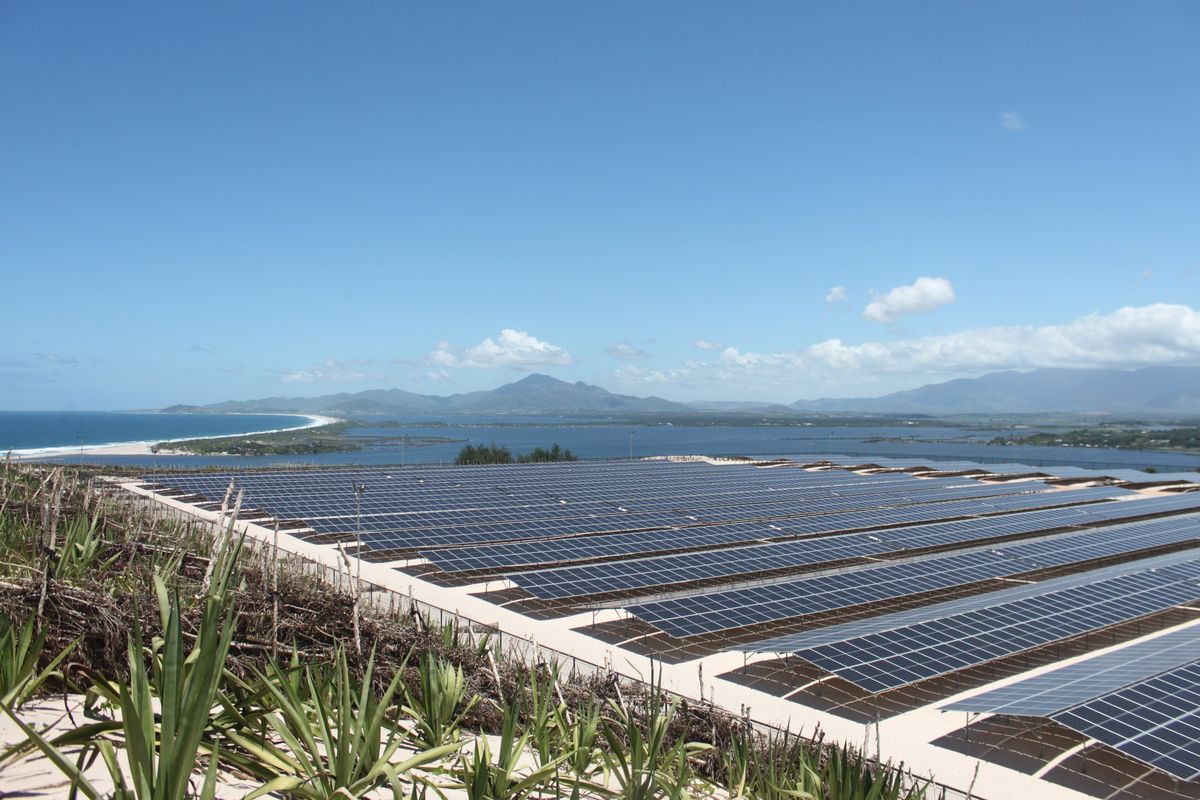
QMM's photovoltaic solar plant near Fort-Dauphin, with Anosy's lakes and mountains in the background
Hybrid solar-wind
14 MW solar · 16 MW wind
14 MW solar 16 MW wind 16 MWh storage

QMM Renewable Energy

With CrossBoundary Energy, QMM commissioned a 14 MW solar plant, then in July 2026 Madagascar's first wind installation. Together they supply up to 60% of QMM's electricity.

To decarbonise its operations and supply Fort-Dauphin, QMM relies on a hybrid plant built and operated by the independent producer CrossBoundary Energy under a 20-year power purchase agreement signed in 2021. The 14 MW solar plant is in service; the 16 MW wind farm (19 turbines), the country's first wind installation, was commissioned in July 2026. 16 MWh of battery storage and 21 MW of back-up thermal generation complete the system. According to Rio Tinto, the project supplies up to 60% of QMM's electricity and cuts emissions by about 26,000 tonnes of CO₂ a year; QMM also supplies the town of Fort-Dauphin (about 80,000 inhabitants) in partnership with JIRAMA.

14 MW solar in service
16 MW wind (July 2026)
60% of QMM's electricity (max.)
26 000 t CO₂ avoided / year
  • Solar: 14 MW — in service
  • Wind: 16 MW, 19 turbines — commissioned in July 2026
  • Storage: 16 MWh of batteries + 21 MW of back-up thermal power
  • Impact: up to 60% of QMM's electricity, ~26,000 t of CO₂ avoided per year
  • Sources: Rio Tinto — riotinto.com (Madagascar operations) · CrossBoundary Energy
Artisanal mica and sapphire mining, Amboasary Sud district, Madagascar
Value chain to be organised
Amboasary Sud
Mica Sapphires Graphite Salt · Zeolites

Artisanal Mining

Amboasary Sud district (communes of Tranomaro, Maromby, Behara) concentrates artisanal mining: mica (insulation panels, cosmetics), sapphires (jewellery), graphite, grandidierite and thorium.

The subsoil of the Anosy Region, particularly in Amboasary Sud district, contains several deposits mined artisanally or semi-industrially. The Tranomaro, Maromby and Behara areas are documented by Mindat as historic mining sites for mica, sapphires, grandidierite and thorium. Mica (a layered silicate) is used as high-voltage electrical insulation, a pearlescent cosmetic pigment and a filler in paints and plastics. Sapphires (corundum Al₂O₃) from regional deposits supply the international jewellery market after appraisal and cutting in Antananarivo. This sector remains largely informal and faces structural issues: working conditions, traceability and in particular the USDOL/Terre des Hommes programme against child labour in mica (SOMO 2019 estimates about 22,000 mica miners in Madagascar, about half of them children aged 5–17).

Mica insulation + cosmetics
Sapphires international jewellery
Graphite Li-ion batteries
1 district Amboasary Sud (main)
  • Mica: electrical insulation, plastic filler, pearlescent cosmetics
  • Sapphires: corundum Al₂O₃ — jewellery, cut in Antananarivo
  • Graphite: Li-ion battery anodes — potential for the energy transition
  • Issues: traceability, working conditions (USDOL programme — mica)
  • Source: Mindat (loc-58234) · SOMO/TdH 2019 · USGS
Artisanal granite quarry in Madagascar, extracting building stone
High potential
Construction & industry
Granite · quartz Apatite Agricultural phosphate Anosy · Androy

Industrial stones & minerals

Granite and building stone, quartz, apatite associated with mica: these resources supply building sites and regional industry, and the authorities are working to formalise them.

Industrial stones are rocks and minerals used for their physical or chemical properties: building stone and aggregates, quartz, phosphate minerals… In Anosy, the mining authorities recently inspected extraction sites for industrial stones, iron ore and mica in Anosy and Androy to formalise a sector that is still largely informal. Some Betroka phlogopite deposits are also very rich in massive apatite, a phosphate. Local demand is supported by building sites (roads, port, buildings); the first steps towards adding value are regulated quarries, calibrated crushing and studying agricultural uses of the phosphate. Bauxite reserves were also estimated in the Manantenina area in the 1960s.

Construction strong local demand
Apatite associated with mica
Formal oversight under way
2 regions Anosy · Androy
  • Resources: granite and aggregates, quartz, apatite, iron ore
  • Markets: roads, port, construction, soil improvers (to be studied)
  • Oversight: inspections and formalisation of small-scale miners (Anosy-Androy)
  • Sources: Newsmada (small-scale miners Anosy-Androy) · Mindat · USGS Minerals Yearbook
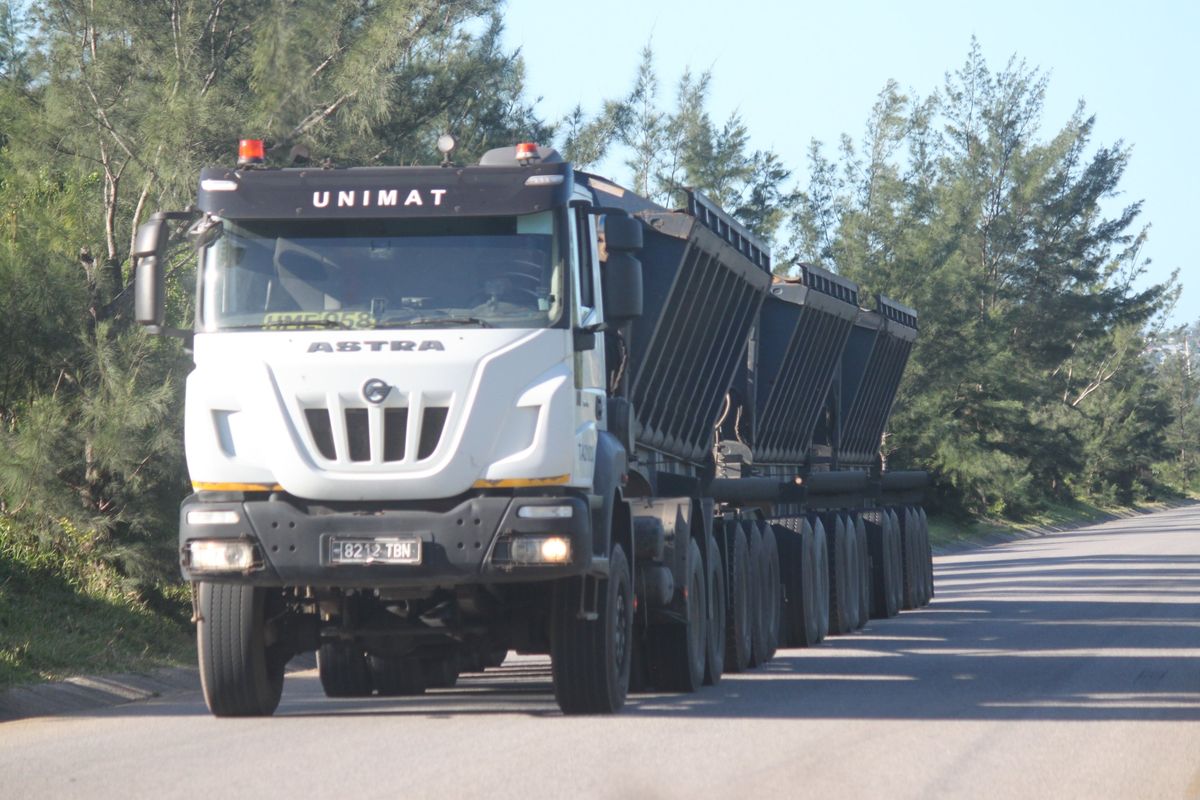
Multi-trailer ore truck on a road in the Fort-Dauphin area
Port of Ehoala
Vertical integration
Deep-water port Logistics Worldwide exports

Mining Supply Chain

Vertical integration between the Mandena mine and the Port of Ehoala (15.75 m draught) is a structural competitive advantage — direct haulage over ~13 km on a dedicated road.

One of QMM's major strengths is its direct logistics link with the Port of Ehoala, built as part of the mining project and co-funded by Rio Tinto and the Malagasy State (PIC project) for USD 145 M. The ilmenite concentrate is hauled by dump truck over ~13 km from the Mandena site to the port's bulk terminal. The port, certified ISPS, ISO 9001 and ISO 14001, has a 15.75 m draught allowing it to handle Panamax ore carriers. The main shipments go to the RTIT complex at Sorel-Tracy (Quebec, Canada), where the ilmenite is turned into titanium slag with 80% TiO₂. This integrated chain explains the competitiveness of Anosy ilmenite on the world titanium market.

13 km Mandena → Port of Ehoala
15,75 m draught
$145 M port investment (2009)
Panamax bulk ore carriers
  • Haulage: dump trucks — dedicated 13 km road — Mandena/Ehoala
  • Port: 15.75 m draught — Panamax + cruise ships, ISO/ISPS certified
  • Destination: RTIT Sorel-Tracy (Canada) — 80% TiO₂ slag
  • Partnership: co-funded by Rio Tinto + the Malagasy State (PIC project) — $145 M
  • Source: ehoalaport.com · Rio Tinto QMM Operations
Mapping by mineral

Communes affected
by mining operations

Select a mineral to show all the communes (rural and urban) of the Anosy Region concerned by its mining or its official occurrences — with the operating companies where known. Minerals officially listed in the 2023 Mining Code are shown whether or not they are currently mined.

Active operation Planned / in preparation Artisanal mining Occurrence identified
Legal & institutional framework

Regulatory framework
Regulation of the mining industry in Madagascar

Madagascar's mining sector is governed by a precise legal and institutional framework, combining the Mining Code, environmental obligations and international transparency commitments. All the links below point to official documents published by the Malagasy authorities.

Regulatory institutions

The Ministry of Mines and Strategic Resources sets national mining policy. The Madagascar Mining Cadastre Office (BCMM) manages the granting, renewal and cancellation of mining permits. Several specialised bodies are involved: COM (Mining Grants Committee), BGGLM, OMNIS, KRAOMA. At regional level, the Anosy Region takes part in the territorial planning of mining projects.

Environmental oversight — ONE

The National Office for the Environment (ONE) reviews the Environmental and Social Impact Assessments (ESIA) required for any industrial mining project under the MECIE decree. Mining projects must obtain a prior environmental permit, followed by an environmental clearance at each phase. ONE also oversees environmental specifications and compliance with them.

Transparency — EITI Madagascar

Madagascar has been a member of the Extractive Industries Transparency Initiative (EITI) since 2008. EITI Madagascar publishes annual reports reconciling payments by extractive companies with revenue declared by the State, and keeps the public list of mining permits up to date as open data. EITI Madagascar's 2023 Mining Guide summarises the permit procedures under the new Mining Code.

Mining permit categories

The 2023 Mining Code provides for several categories of title: Exclusive Perimeter Reservation Authorisation (AERP), Exploration Permit (PR), Mining Permit (PE) and Small-Scale Miners' Permit (PRE). QMM operates under a Mining Permit combined with a specific establishment agreement. Permits are geolocated and can be viewed on the BCMM cadastral portal.

This page summarises official sources as at the date of publication. For any actual regulatory procedure, refer to the texts in force published on mines.gov.mg and bcmm.mg.

Economic spin-offs & CSR

Structuring commitments
for host communities

Tax revenue

  • QMM taxes paid to the State (cumulative since 2006) >$131 M
  • Community commitment (25 years) >$100 M
  • State – Rio Tinto partnership renewed 2023
  • Initial investment in the Port of Ehoala (PIC) $145 M
  • RN13 investment (March 2025) Ar 94 bn

Employment & Supplier Development

  • QMM Supplier Development programme Active
  • Bringing local SMEs into the supply chain In progress
  • Indirect employment (subcontracting, services) Significant
  • Local technical training Active
  • USDOL programme — artisanal mica In progress

Decarbonisation & environment

  • QMM solar plant 14 MWp Operational
  • QMM 16 MW wind farm (Madagascar's first) June 2026
  • 16 MWh battery storage Planned
  • Supplies Fort-Dauphin (~80,000 inhab.) Active
  • Ecological restoration programmes Monitoring

Transparency & governance

  • Member of EITI Madagascar (since 2008) Member
  • Rio Tinto (group) annual reports Public
  • QMM Water Reports (published) Annual
  • Madagascar Mining Code (Law 2023-007) In force
  • Dialogue with communities / NGOs (ongoing) Permanent

Main sources: Rio Tinto QMM · CrossBoundary Energy · EITI Madagascar · Ministry of Mines · BCMM · ONE · USGS Mineral Industry 2019

A balanced reading of the sector

Challenges & points to watch
for an honest analysis

Any rigorous assessment of the mining sector weighs its challenges alongside its strengths. These data, from official sources and independent publications, provide an essential balanced reading.

Water management

  • QMM publishes annual Water Reports on monitoring of the site's ponds
  • The latest report (April 2026, period Nov. 2024–Oct. 2025) monitors the physico-chemical quality
  • Debates with NGOs (London Mining Network, ALT, etc.) concern transparency on discharges
  • A structural issue for any hydraulic dredging site in a sensitive coastal zone

Source: Rio Tinto QMM Water Reports / ALT / London Mining Network

Child labour — mica

  • Artisanal mica in southern Madagascar is affected by child labour issues
  • SOMO/TdH 2019: ~22,000 mica miners in Madagascar, about half of them children aged 5–17
  • Programme of the U.S. Department of Labor (USDOL) and the Responsible Mica Initiative
  • An artisanal sector to be clearly distinguished from QMM's industrial operation

Source: SOMO/TdH 2019 — USDOL — RMI

Biodiversity & coastal forests

  • Mandena, Sainte-Luce and Petriky lie in areas of high endemic biodiversity
  • Ecological restoration and in situ conservation programmes
  • Cooperation with conservation partners (Asity Madagascar, etc.)
  • Monitoring the sensitivity of coastal forests and associated wetlands

Source: Rio Tinto QMM Biodiversity Programs / ReliefWeb Petriky

Market volatility

  • World prices of TiO₂ and zircon are volatile with industrial cycles
  • Concentration of markets (RTIT Canada — geopolitical risk)
  • Competition: Australia, Mozambique, South Africa in mineral sands
  • New 2023 Mining Code being implemented — implementing decrees still to be finalised

Source: USGS Mineral Commodity Summaries / EITI Madagascar

Opportunities in the mining sector

Anosy's mining sector
at your scale

Industrial subcontracting, QMM supplier development, adding value to artisanal mining, services to mining operations — explore the business opportunities linked to the Anosy Region's leading economic sector.

Continue exploring
the economy of Anosy